

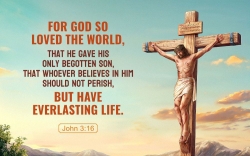
God Loves the World
Text: John 3:1-17
Grace, mercy, and peace be to you from God our Father and from our Lord and Savior, Jesus Christ.
On the side of the fellowship hall at Camp Pioneer in New York on the shores of Lake Erie in 12-inch-tall letters reads the words of John 3:16. “For God so loved the world that He gave His only Son, that whoever believes in Him should not perish but have eternal life.” Right there for all eyes to see as campers and parents made their way to gatherings, passing by it multiple times a day on the way to the waterfront. Many people stop and take notice of that message, but I imagine that after a while a lot of people just walk right by it, failing to recognize the significance of those words. But they’re still there for all to see and reflect on. And hopefully those words have the impact that God intends them to have.
Those words have been called the Gospel in a nutshell. God’s promise of salvation wrapped up in a tight little package for all to hear and see. But I think that like those foot tall letters on the side of the building, the message might sometimes get lost in the package. The nutshell is sometimes so tightly wrapped that the message is kept inside. Like when someone holds up the sign at the football game that simply says John 3:16. For those in the know, the message shines right through the wrapper of the biblical reference of chapter and verse. But for those who don’t know, all that is is a name and some numbers.
The first verse that I give every Confirmation I class to learn by heart is John 3:16. Because they’re generally already at least somewhat familiar with it, it serves as a model for learning how to learn by heart, or memorize. We take it phrase by phrase and learn it together. And in doing so, we’re reminded of the core message of the Gospel that, “God so loved the world that He gave his only Son, that whoever believes in Him should not perish but have eternal life.” The core message of the Gospel is that
GOD LOVES THE WORLD
It’s the simplest and clearest expression of who Jesus is and what he came to earth to do. We try to make it more complicated than it is, but really, it’s very simple. Jesus came to save the world. I guess it’s not that simple though, because then you have to ask the question, “save the world from what?” Save the world from itself, from Satan, and, most obviously, he came to save the world from death.
But here’s the problem, and it’s one that Christianity has sought to answer since Jesus rose from the dead and ascended into heaven. If Jesus conquered death by his death on the cross, why, then, do we still die?
For an answer to that question, we have to turn back to the Old Testament and the people of Israel. The children of Israel in Numbers chapter 21 are wandering in the desert. They’re partway through their forty years of wandering, when God teaches them how to listen to His Word and trust that He’ll provide for all their needs, both physical and spiritual. But the children of Israel are much like us today. They could be a little slow to learn and put God’s Word into practice. And above all, they’re rebellious. They’re so rebellious, in fact, that God sends serpents to go and bite them. Many of them died. “The wages of sin is death,” as St. Paul reminds us. But then we read the following: “And the people came to Moses and said, ‘We have sinned, for we have spoken against the Lord and against you. Pray to the Lord, that He take away the serpents from us.’ So Moses prayed for the people.”
Moses agreed to do what the people asked because he recognized their repentance. He saw that they knew their sin and their need for redemption. So, Moses prayed to God and God answered him by giving Moses instructions on how to save the people. The Lord said to Moses, “Make a fiery serpent and set it on a pole, and everyone who is bitten, when he sees it, shall live.” Moses obeys the Lord, even though you have to admit, this is rather odd. Put a snake on a stick? Isn’t that snake the form that Satan took in the Garden of Eden? Yes, it is. But why look to the snake for healing when that’s the image of the one who tempts? And the very real image of the creature that’s attacking them?
There are two things that really stand out in this account from the people of Israel. First is that the form of their salvation and life isn’t much to look at. A bronze serpent isn’t exactly something you’d think would give them a lot of hope. That point we can see. Because the connection to Jesus on the cross is obvious. Isaiah says that “He had no form or majesty that we should look at Him, and no beauty that we should desire Him.” The second point is a little less obvious. The snakes still come. Nowhere in the text do we get Moses wrangling all the snakes, pulling out the shovel to cut them in half, or sending them down into the river to drown. God didn’t take away the serpents. He gave the people a way out, a way of salvation, so that even though they were bitten, the bite didn’t kill them. Whoever looked upon the bronze serpent in faith, that person lived.
Now let’s fast-forward to Jesus speaking with Nicodemus in John’s Gospel for this morning. Jesus uses this event in the life of Israel to show Nicodemus how God works. God works in the world like this. He doesn’t take death away. Not yet, at least. What he does is send his Son into a world of death, so that He dies in our place. As we hear in verse 16, “For God so loved the world that He gave His only son.” To whom did he hand Jesus over? He handed Jesus over to sin, death, and Satan himself, the unholy trinity that makes up the evil we all live with every day. This is the way God chose to show His love to the World.
Jesus then takes the punishment that you deserve, gives you eternal life, which is His by nature, and sets you up as sons and daughters given eternal life in His kingdom. All because God the Father hands Him over to death.
So, for you here and now today, you still suffer death and the effects of sin. You get sick and injured. Things don’t work as they ought to work. The serpent still bites at your heels. But Jesus Christ has crushed the head of that old evil foe. By His death, He has destroyed death, so that what we endure and suffer now is mere aftereffects, rumblings and thrashing from a foe that has already lost but wants to drag as many people down with him as he can.
Make no mistake though, you belong to Christ, and Satan can’t harm you. Jesus doesn’t come into the world to scold you for your sins and failures. He doesn’t come to shake his head and urge you to do better next time. He doesn’t come to give you an example to shoot for, or a target to reach. His goals are much, much higher. Remember again verse 17 from chapter 3 of John: “For God did not send his Son into the world to condemn the world, but in order that the world might be saved through him.”
That’s God’s plan for you and for the entire world. He wants to save you, to heal you, to comfort you, to love you, and to give you hope that no matter how much the snake bites, you can lift up your eyes and your heart to the cross of Jesus Christ, and in that cross, a symbol of shame as much as any serpent, in that cross you will find life—real, abundant life that has no end, because He has no end.
So come, blessed children of God, and receive the gifts of the kingdom of heaven prepared for you before the foundation of the world. Come and rejoice in his body and blood. Receive the forgiveness He offers here. And give thanks for all His benefits, for the mercy of God endures forever. Amen.
The peace of God which surpasses all understanding guard your hearts and your minds in Christ Jesus.

Leave a Reply