
For All the Saints
Text: 1 John 3:1-3
Grace, mercy, and peace be to you from God our Father and from our Lord and Savior, Jesus Christ.
Today is All Saints’ Day. It’s a day set aside to remember those saints who have gone before us into the heavenly realm, having finished their course on this earth and having received their eternal reward. Today we remember Bob and Bob from our own congregation who entered that eternal glory this year, but you’re probably also thinking about others. Maybe someone else who died this year. Or maybe it’s been a lot longer than that. Today is a day to remember all those we have loved who are no longer with us, and celebrate those whose faith has made them well. For all eternity in the presence of Jesus.
Today is also a day to contemplate the true nature and purpose of the Church. One way for us to do that is to consider the words of our creed. Specifically, the Nicene Creed. The statement of the universal church from all the way back in 325 AD that outlines our core beliefs about God – Father, Son, and Holy Spirit. I got to thinking about the creed this week because I happened to be in another service where the creed was proclaimed. And generally, I’m struck by the fact that wherever you might go, the creed is confessed in the same words as it was written 1,700 years ago. In fact, many places have been celebrating this year that the creed has remained intact for all these centuries.
But this week I was reminded that there are those who would like to go their own way. Believing that improvements can be made by changing words to either suit a certain theology, or to cater to those who have a particular axe to grind. In this service I attended, the phrase “God of God, Light of Light” was changed to “God of Gods, Light of Light.” It’s a subtle change, but it makes a huge difference in the meaning. Our God, Father, Son, and Holy Spirit, is not just a God among many gods. He is God. The one. The only. I would have been willing to chalk that up to a mistake of the tech guy who put the slide together that was projected on the screen at the front of the chapel, except that later on in the creed was the line “who for us and for our salvation came down from heaven.” Again, maybe it’s subtle, but the line is “who for us men,” meaning all people. The kicker was the removal of all gendered language for God in the preface leading into the communion service.
Despite my experience this week, I’m still awed by the fact that the Christian Church here on earth, for the most part, has a statement of belief that unites us. That we can go just about anywhere and proclaim our faith in words that we’ve learned, believed, and cling to as the statement of our faith in the one Triune God. Each week we confess in the Creed that we believe in, “one holy Christian and apostolic Church.” Each one of those words is important. First, we say that the Church is ONE. But how can we say that the Church is one? Look around, there are Catholics, Orthodox and Protestants. And then within the Protestant Church, there are Methodists, Baptists, Pentecostals, Presbyterians, Lutherans, or any of a number of non-denominational churches. So many choices that no one is even totally sure how many. Some studies estimate that there are over 45,000 Christian denominations across the world. How is a Christian to know whether he or she belongs to the one true church of Christ? As Lutherans, we have an answer to this question. We never say that we are the only true church on earth. We’re not that arrogant. What we do say though is that the true Church on earth can be identified by certain outward characteristics. That is to say, there are certain identity markers that let Christians know where the true Church on earth is to be found. What are those markers? Simply put it’s the Word and the Sacraments. Where the Word of God is taught in its truth and purity and the Sacraments are administered according to God’s command there the true Christian Church can be found. That was Christ’s command when He sent His disciples out to preach, teach and baptize. The Church as a whole does many things, it runs many programs, it assists people, but what makes the Church the Church is her continual connection to God’s Word and Gifts. Therefore, it doesn’t necessarily matter what the Church sign out front says. What matters most is what takes place within the sanctuary.
If you’ve ever heard our District President speak, you’ve probably heard him talk about the work of the church happening around altars, pulpits, and fonts. Everything we do should be directing people to the gifts that God delivers right here. Is God’s Word preached every Sunday? Is God’s Word taken seriously? Is the Word preached in all its power— never compromising the message or sidestepping the hard teachings of Christ? Are God’s gifts held in the highest honor and handled with the utmost reverence? Is Baptism understood to be a lifesaving regeneration and renewal whereby God washes the sinner clean and creates a new nature within the newly baptized? Is the Lord’s Supper celebrated often? Is it understood to be what God says it is—the true body and blood of Christ given and shed for the forgiveness, life and salvation of His people? If someone can answer yes to these questions then he or she can be assured God is present and active in the service. If the answer is no, then that’s something else entirely.
Back to that phrase in the creed “one holy Christian and apostolic Church.” We call the church HOLY. Of course, only God is holy. Therefore, only He has the right to grant the status of holiness to someone else. We’re not holy in and of ourselves and we can never make ourselves holy in God’s sight. Holiness is a gift of God. We’re holy by our connection to God. God grants His holiness to those who call upon His Name. Today we remember all the holy saints of God. And we shouldn’t limit this title of saint only to the saints now in heaven. By our connection to God and by the redemption we have in Christ we too are saints right now. Even on this side of heaven we say with Luther that we are both saints and sinners. This means that we’re saints because God is with us, but we remain sinners by our own nature and actions. We are both then—simultaneously saint and sinner, and we will remain so until Christ calls us home to heaven.
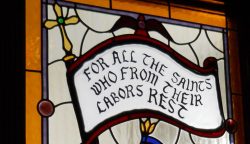
So, there are saints in heaven and saints on earth. What’s the difference? If you look at your hymnal the distinction is made clear for us in the hymns we sing. The hymnal divides our hymns about the Church and her saints into two categories- The Church Militant and The Church Triumphant. Today most of our hymns are about the Church Triumphant that is the Church that exists for all eternity in God’s holy presence. Everyone who dies in Christ enters the Church Triumphant and joins the wedding feast of the Lamb in His Kingdom, which has no end. The Church Militant on the other hand is all about the here and now. Right now, we are part of the Church Militant and we must continue to fight the good fight of faith on earth. We look forward to being part of the Church Triumphant when we will join with all the saints who have departed in the faith and now rest from their labors.
This is the reality that John speaks of in our Epistle for today. “See what kind of love the Father has given to us, (or in some translations, has lavished upon us) that we should be called the children of God; and so we are.” It’s a love that was showered upon us even before we were formed in our mother’s womb. It’s a love that is with us throughout our lives as we walk with the King of Love who knows us and leads us. And it’s a love that won’t end when our time on earth does. As John says, “Beloved, we are God’s children now, and what we will be has not yet appeared; but we know that when he appears we shall be like him, because we shall see him as he is.” This is the beauty and the mystery of the church. That we are the bride of Christ who has loved us since the beginning of time and will continue to love us for all eternity. And when we get to see Him face to face, like many of our loved ones already do, we will know that love in an even greater way than we can now imagine.
Finally, in the creed we call the Church CHRISTIAN and APOSTOLIC. This means that we trace our roots back to the teaching of Christ, to the original band of disciples, to the first Christian Church on earth. To be the Church of the apostles is to confess Christ at the center of all that we do as Peter, James, John and the whole company of the apostles once did. We share with them in the universal mission to reach the lost and in the one universal faith of Christ our Lord.
All Saints Day puts us in touch with these greater realities, these unseen wonders of God. It touches on the mystery of how everything is connected. How we remain connected to the saints who have gone before us by remaining the saints who wait for the reward of our faithfulness. And who, in our waiting, receive the assurance of God’s love through the gifts He offers us in His Church. Through Word and Sacrament. Which is why we love the Church. Why we fight for the Church. Why we support the Church and her work. And why we rejoice in the blessings that we receive here in this place. The Church isn’t perfect. Many of us have experienced that in various ways. And that’s because it includes us. Sinners and Saints struggling to walk the road our Lord has laid out for us. But one day the Church Militant will become the Church Triumphant. And all division and conflict will cease. And all those who remain faithful to the One who gave everything for us will be reunited with the saints who have gone before us in the glory of life everlasting. Forever in the presence of the Father, the maker of heaven and earth. And in Jesus Christ, who for us men and for our salvation came down from heaven. And in the Holy Spirit, the Lord and giver of life. What a glorious day that will be. Amen.
The peace of God which surpasses all understanding guard your hearts and your minds in Christ Jesus.

Leave a Reply